
Enemy shelled Mont St. Eloy yesterday causing casualties.
Thursday 1 February 1917
– fine
Enemy sending over 5.9” naval shells into La Targette. I go to see if my boys are alright as a shell pitched just outside their dugout. As I near the place a screaming shell bursts & the air is black with debris. The boys are alright.
In afternoon about 3:30 pm 5 enemy aeroplanes attack one of our machines (a Bristol) and succeed in forcing it to descend in our own lines at back of front line. Fritz strafes it with shells. Another of our machines takes its place & the enemy move off.
Wednesday 31 January 1917
Enemy active in morning. At noon I go up to O.P.’s to observe the fire of our 9.2” on Prinz Arnolf Graben and other objects. The enemy retaliated with the most terrible hell of a bombardment. We had to take cover not before we had made good observations. I called on P.P.s Regtl. Sergt. M. and rec’d a copy of Regtl. Order containing my “Mentioned in Dispatches”.
*O.P.’s…Observation Post
*Prinz Arnolf Graben was a German tunnel, one of many dug by both sides at Vimy Ridge.
*O.P. Trees ~ Built using steel and wrought iron, these are no normal trees. They are camouflaged weapons of war used to devastating effect during World War I on the Western Front. The bizarre fake tree observation posts were built to spy on the enemy after switching them under cover of darkness with real battle-scarred stumps left in no-man’s land. The ideal tree was dead and often it was bomb blasted. The photographs and sketches were then sent to a workshop where artists constructed an artificial tree of hollow steel cylinders. It contained an internal scaffolding for reinforcement, to allow a sniper or observer to ascend within the structure. Then, under the cover of night, the team cut down the authentic tree and dug a hole in the place of its roots, in which they placed the O.P. Tree.

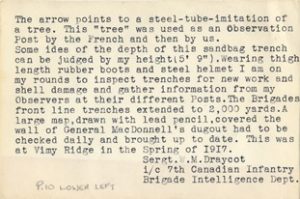
Tuesday 30 January 1917
Up the line with a runner. Visit several [Hqr]. Make several surveys. Enemy very active. Several aeroplane fights.
Monday 29 January 1917
Busy making blue prints in morning.
Observer Whiteside and I make tour of unknown trenches & gain valuable information in reference to them. Enemy snipe and shell us as we pass overland.
Sunday 28 January 1917
– frost
About 4 am a party of PPCLI attempted to rush enemy’s post but enemy being on alert beat them off. Our casualties 2 slightly wounded. Our party killed two of enemy in post and then withdrew.
A Raiding party from 49th succeeded in entering enemy trenches capturing 8 prisoners. We suffered no casualties. Weather very cold. Snow & frost.
Lt. Little (PPCLI) is wounded slightly.
*The 49th Battalion (Edmonton Regiment), CEF, was an infantry battalion of the Canadian Expeditionary Force during the Great War. The 49th Battalion was authorized on 7 November 1914 and embarked for Great Britain on 3 June 1915. It disembarked in France on 9 October 1915, where it fought as part of the 7th Infantry Brigade, 3rd Canadian Division in France and Flanders until the end of the war. The battalion was disbanded on 15 September 1920.The 49th Battalion recruited in and was mobilized at Edmonton, Alberta. (www.wikipedia.org)
Saturday 27 January 1917
– frost
At 8:20 am a raiding party from PPCLI under Major A. Rasmussen & 12 OR [entered] enemy’s line under a Stokes barrage. Raid successful. A number of dugouts being bombed. Many casualities inflicted. Enemy’s post destroyed and two prisoners brought in. Our casualties nil. Weather frosty with snow. Our Stokes fire 666 rounds.
*OR is an acronym for Other Ranks
*Frederick Wilfred Scott Stokes – who later became Sir Wilfred Stokes KBE – designed the mortar in January 1915. The Stokes mortar was a simple weapon, consisting of a smoothbore metal tube fixed to a base plate (to absorb recoil) with a lightweight bipod mount. When a mortar bomb was dropped into the tube, an impact sensitive primer in the base of the bomb would make contact with a firing pin at the base of the tube, and detonate, firing the bomb towards the target. Range was determined by the amount of propellant charge used and the angle of the barrel. (www.wikipedia.org)
Friday 26 January 1917
I go to craters on front line Litchfield & Watling & afterwards visit the “O’Pips”. Enemy heavily shelling. Our trench mortars are very active. Pte. Wilson accompanies me. I do a little sketching of enemy’s machine gun positions.
*Litchfield & Watling are the names of large mine craters near Vimy Ridge. Today Lichfield Crater is essentially a mass grave with 57 burials, 15 of which are unidentified. Of the 42 known burials, all except one are of Canadian soldiers, 39 of whom died on the 9th of April 1917.
* O-PIP ~ Observation Post (OP). From the phonetic alphabet (www.ict.griffith.edu.au)
Thursday 25 January 1917
– frost
Enemy shell us vigorously with 7.7 cc shells for 3 hours. No damage except to disturb graves. I make investigation of his shells & find location of his battery. Make sketch & plan & submit same to Artillery thru’ our Intell. Officer. He sends the 1st 1916 Shell over, previously they have been 1915. They’re made @ Strassburg.
Wednesday 24 January 1917
– frost
Up the front line with Pte. Collins. Much shelling. See an enemy sentry on sentry – go. On our return we visit the caves. In evening the enemy shell our quarter with 5.9’. Hell on our left. Intense bombardment.
* In the days leading up to the historic battle [Vimy], Canadian troops were housed in a series of underground caverns and tunnels to keep the build up of troops secret from the Germans, said Rory Cory, senior curator for the Military Museums. Boredom reigned, leading some to begin doodling or carving images into the cave walls. (www.canada.com)
- « Previous Page
- 1
- …
- 48
- 49
- 50
- 51
- 52
- …
- 145
- Next Page »


