
Rain ceased but not the artillery which still roars. I go sniping in morning & bag 2. Fire 150 shots. They fired in return & nearly get me but Dame Fortune favours me once more.
Artillery duel on our right. A German sniper manages to put a bullet through Corporal Bramley-Moore’s head. He is still lingering between life & death at 7:30 PM. His face is a horrible sight to gaze on & covered in blood.
The 43rd Regt. relieves us. I act as guide to the 4th CMR. 43rd Regt. & stood on “point duty” at “Charing Cross.” The enemy search the woods with machine guns & I am forced to lay down on leaves at 10:30 PM. (one [or, four?] of officers of 43rd extremely drunk)
Monday 27 March 1916 – rain and fine later
Absolutely the most wicked weather last night boys outside all night. Rain snow sleet & driving wind. Hard pounding rifle grenades & trench mortar bombs are sent over in profusion. Hell opens again at 4:30 am by our artillery at Hill 60. A most hideous & frightful roar & noise. A rifle shot can scarce be heard. Aeroplanes very active. Fly low. Our feet are wet and life almost unbearable.
As I am standing outside the dugout a shrapnel bullet passes my neck and buries itself deep into the sandbag. Again I miss death by a rifle grenade. 3 burst simultaneously near dugout in fire trench. All night there is a horrible hell & din going on.
It rains all night and the misery – pitiful as we stand out in it all through the night.
*Hill 60 – A heap of soil just south of Ypres in Flanders made from soil removed from a cutting for the Ypres-Comines railway. The hill was a strategic observation point overlooking Ypres and Zillebeke making it a valuable target and thus the area of multiple battles throughout the duration of the war.
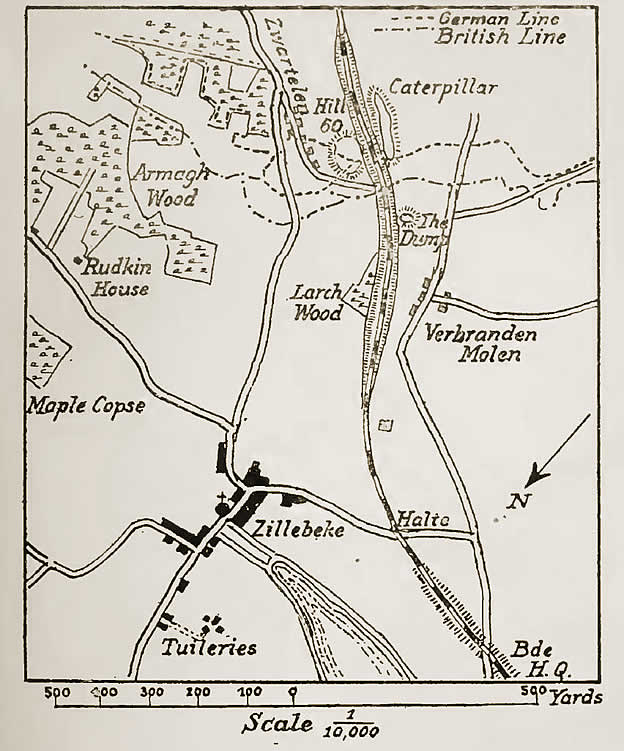
“Hill 60, 1915” by E Wyrall – Wyrall, E. (1921) The History of the Second Division, 1914–1918 Vol I (N & M Press 2002 ed.), London: Thomas Nelson and Sons Retrieved on 13 November 2013. ISBN: 1-84342-207-7. Licensed under Public domain via Wikimedia Commons – http://commons.wikimedia.org/wiki/File:Hill_60,_1915.jpg#mediaviewer/File:Hill_60,_1915.jpg
Sunday 26 March 1916 – rain
Very few dugouts in front line trenches so some of us have to stay out in rain all night. As I leave a bag where my equipment is, a shell comes along and kills one and the other poor fellow has his head badly shattered… his brains cover his face. Raining hard all day. Pvt Dietz & Pvt Basset are dead.
Dietz lays in pool of blood with right arm blown completely off by 88 mm (whiz bang). My equipment a tangled mess and my bayonet twisted. A most frightful bombardment goes on all afternoon. The 2nd C.M.R. mainly wiped out. Awful Hell. Men running everywhere to escape. A most unmerciful artillery fire. The ground shakes like quagmire at night a hellish din by bombs of all sorts.
Saturday 25 March 1916 – frost
Hard frost during night which added to the discomfort of the troops.
In afternoon the Germans shell our trench most unmercifully. Hell let loose. Hundreds of casualties. Dugouts blown up in the air, trees smashed down. Shells, trench mortar bombs, aerial torpedoes & other missiles employed.
We go up to bird cage trenches. Raining & troops miserable. The bursting of trench mortar bombs and grenades make vivid flashes and a deafening noise.
Boys have wet feet. Pvt Forster killed.
Wounded – Pvt Smith, Mason & ..
Friday 24 March 1916 – snow

“Zillebeke Village [view of the ruins]” Public domain via Vancouver Archives http://searcharchives.vancouver.ca/zillebeke-village-view-of-ruins
The whole district is in its winter clothing.
Troops very miserable. No dry wood for cooking. Young Baker and I go to an old dilapidated farm & get some. We are under fire & ‘tis against orders to go but – ?
Late in the afternoon Boulanger & I go into Zillebeke. Visit church lots of tombstones broken & fallen down by shellfire. A shell unearths a vault which shows the embalmed body of a being encased in zinc coffin. Also body of Baroness J.M.A.C.G. de Vinck de Winez etc., etc. Heavy shelling all night also trench mortars. Hell on earth.
Thursday 23 March 1916 – snow
A cold wet miserable day.
Severe shelling by both sides accompanied with trench mortars & rifle grenades make the whole scene a perfect hell.
The snow comes down in small flakes but does not stick.
Eleven of the 42nd rifle suffer, six C.M.R.’s.
I got to headquarters & brigade Hqs & go through Zillebeke also pass by Zillebeke lake. A mile long shells are bursting all around. Am saved nasty head wound by wearing steel helmet.
*Rifle Grenade – Grenades that could be fired from a rifle thus increasing their effective range. During World War One, specialized grenades were attached to rods that had to be inserted into the barrel of a rifle. A blank cartridge was fired to propel the grenade towards the enemy.
Wednesday 22 March 1916 – drizzle
Up at 7 am. Rum issue at 7:30 am. Am on trench police duty, bullets flying everywhere. One of the C.M.R.’s pass me on stretcher – shot through lung by sniper – small chance of recovery.
‘Tis raining again, a most miserable day with a good depth of filthy mud. Our dugouts have been well battered by shells all morning until 3 PM. The Huns rain shells in on us.
Tuesday 21 March 1916 – mist, rain
The C.M.R. transport are blown up by shells.
Battn moves to Bde reserve via Kruystraat [sic]. Ypres at 5 PM at Zillebeke (sanctuary woods).
Rained a drizzly rain & all troops wet thru. Lost our way. Back to village of Zillebeke. Entered long line of trenches halted in middle. Boys tired (10 PM) laid down in mud. Rain beat down on faces, bullets flying everywhere also shells. Company absolutely fed up. Many fell down shell holes. Enter very small dugouts at 10:30 PM. Sleep with knees up all night out there. Dugouts for 2 had to take 4. Absolutely rotten management.
Our battalion open up with terrific bombardment.
*Sanctuary Woods – Just east of Ypres, the wood was named by British soldiers in 1914 as it was used to shelter troops. Canadian troops were stationed here during 1916 and the woods were defended by Canadians from the Germans during the Battle of Mount Sorrel.
Monday 20 March 1916 – fine
My [rucksack?] is carried by transport wagon. I march with Coy. to Ouderdom near Poperinghe encamped in huts.
Many aeroplane fights.
Huns shell Dickebusch and Ypres all afternoon.
Bombs from German aeroplane drop near our huts.
No casualties.
*Poperinghe- One of only two towns in Belgium that was not under German occupation during WWI. It was used to billet troops just behind the front lines and as a safe area for hospitals.
Sunday 19 March 1916
Inoculation very sore & in state of fever.
Srgt [Shivers?] & Holt also Ostrum go on leave to Eng.
- « Previous Page
- 1
- …
- 79
- 80
- 81
- 82
- 83
- …
- 145
- Next Page »


