
To Vlamertinghe with Lance Corporal MacQueen and Galbraith.
The camp is heavily shelled by Huns. High explosives and shrapnel. Great excitement, horses are cut loose & stampede.
Great fright to see everybody running away from the shells which come over very thick. Dispatch riders ride thro’ it all.
Wednesday 5 April 1916 – high wind, fair
Prince General Galinsky of Russia visits the regiment & inspects it. Band plays Russian national anthem. Our flag is unfurled and flies in the breeze.
Generals Alderson, Plumer & Mercier receive the Prince who has large retinue.
Prince Alexander of Teck also attends.
Our Regt. moves to Brandhoek near Vlamertinge, at night take over huts which were subject to shell fire.
Heavy shelling all night and morning.
Friday 4 August 1916
Exploration of Stewart trench recently captured by Capt Stewart. Discover 4 enemy dugouts 15 feet deep, trench 5 feet deep & 3 to 3 1/2’ wide.
Leave Ypres for Poperinghe to take train for England as my bro’ Harry is undergoing a delicate operation in hospital at Liverpool.
Tuesday 4 April 1916 – fair
Weather changing to cool & prospect of rain.
I go to Elverdinghe to see Sergt. Major Allwork, SM Oxley, SM Rayman & SM _______ . Have quite a Royal time. They beat the guards at football 2-1 Sergt. Heath is there also.
Monday 3 April 1916 – fine and hot
Our brigade headquarters are shelled. One man killed & several wounded.
I get permission to go into Poperinghe. Make purchases & send photos to Harry. Brooches to Mrs Katie Draycot, Miss Southam, Rosary to Mrs Smith (& Crucifix), Crucifix to my aunt Louise.
English beer & stout forbidden to be sold in Belgium from tomorrow.
Sunday 2 April 1916 – fine
Battalion is inspected by Brig. General Loomis.
Very hot day.
Saturday 1 April 1916 – fine
Send P Papers off
German aeroplane drops bombs on camp at 5 AM. Some killed & wounded.
10 men killed in camp when bomb goes off accidentally.
Friday 31 March 1916 – fine
German aeroplanes fly over our camp. Antiaircraft guns dot the sky with shrapnel but they escape.
I make application for commission in tunnelling company along with others.
Am turned down, though they asked us!
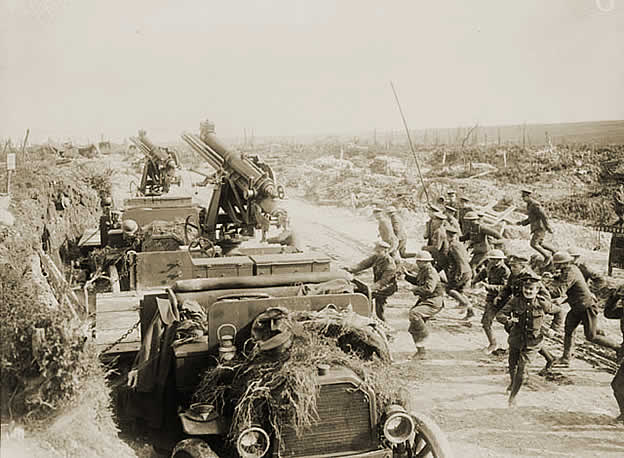
“British anti-aircraft gunners firing at a German aircraft.” Credit: W.I. Castle / Canada. Dept. of National Defence / Library and Archives Canada / PA-000836 Via http://collectionscanada.gc.ca/pam_archives/index.php?fuseaction=genitem.displayItem&lang=eng&rec_nbr=3194240
Thursday 30 March 1916 – frost and cold
At Busseboom near Poperinghe & quartered in hut. Fearful cold night as no door to hut and large cracks in floor. Very dirty.
Vivid memories of the Ypres Salient still haunt me. What a hell! Believe me.
I write letters to Betty, Harry always and Bro’ Charles in France.
A report to hand says on our right two lines of enemy trenches have been taken by Northumberland Fusiliers at St Eloi + Royal Fusiliers.
Wednesday 29 March 1916
I went way down the communications trench to Zillebeke. A most horrid storm arises, the wind howls thro’ the much battered woods (Sanctuary Wood) accompanied by snow, hail, sleet & rain. The night was tempestuous & the elements vied with cannon to make the loudest frightfulness. Hideous in the extreme. I lose my steel helmet so have to trek 5 miles without it, snow & hail mix with my hair, frightfully cold. I fall into many mud holes, shell holes and disused trenches. Am covered from head to feet with mud of all colours & reeking with the stench.
We pass through Zillebeke after taking 3 hours to travel a mile. The 43rd were in the Common trench with full pack on same as us. Difficult to pass each other. Rotten bad management. Passed along Menin road and thro’ Ypres at 3 am & took train outside.
*Brodie Helmet – Also called Steel or Mark I Helmet was the first steel helmet worn by British, Canadian and American troops during the First World War. The use of artillery shells resulted in increased head wounds and made steel helmets a necessity. Their bowl shape with wide brim allowed for protection from Artillery bursting from above the trenches. The Brodie Helmet was used by Canadian forces into the beginning of the Second World War when it was replaced with a modified version.
- « Previous Page
- 1
- …
- 78
- 79
- 80
- 81
- 82
- …
- 145
- Next Page »


